For sushi in Brussels, choose the meal format before the restaurant: casual rolls at Makisu, a traditional à-la-carte meal at Yamayu Santatsu, a takeaway assortment from Nonbe Daigaku or a scheduled tasting menu at Kamo. Prices are not directly comparable across those formats, and Kamo's 2026 menu and service changes make older recommendations particularly unreliable. [1][2][3][4]
The useful budget comparison is the whole meal
A roll, a sushi assortment and a multi-course menu are different purchases. Count what the listed price includes, then add the items you genuinely expect to order. A cheap headline can become a larger bill when it is only one component of dinner.
Likewise, a price per piece can be misleading when the pieces differ in ingredients and size. Use it to understand the order, not to declare one restaurant universally better value. Decide whether the priority is a convenient lunch, a broad selection to share or a meal built around the chef's choices.
The restaurants below are selected for their documented menus and contrasting formats. This is not a personal tasting ranking. The strongest recommendation is the one that matches your preferred experience and the actual service available on your chosen day.
Makisu: casual rolls without a reservation
Makisu describes itself as a fast-casual sushi business and lists Brussels branches including 6 Rue de Flandre, 5 Rue du Bailli, 470 Chaussée de Boondael and 361 Chaussée de Waterloo. It states that tables are for walk-ins and reservations are not accepted. [1]
That makes it useful for a flexible meal rather than a carefully timed special occasion. Choose the branch already near your plans, then have a backup when you must eat at a particular hour. Walk-in service is a format, not a guarantee of immediate seating.
The official online order system did not expose a readable current price list during research, so no delivery-platform amount is presented here as an in-store price. Use the branch's current menu for the total before ordering. That is preferable to giving a falsely precise budget based on a different sales channel.
For a group with different appetites, order in a way that makes sharing clear. Agree which items are shared and which are individual before paying. This avoids a nominally inexpensive meal becoming awkward because several people assumed the same roll was their main course.
Yamayu Santatsu: a lunch opportunity with an important condition
Yamayu Santatsu is at 141 Chaussée d'Ixelles and takes reservations by telephone. Its posted schedule includes lunch Tuesday–Saturday and dinner Tuesday–Sunday, with Sunday dinner starting at 19:00. The English homepage announces closure on 1–3 November 2026 and reopening at lunchtime on 4 November. [5]
The lunch page lists a €19 menu with a small starter, Japanese tea and a choice of main. Santatsu chirashi appears among the choices, but explicitly subject to availability. [6] This is a useful lower-cost possibility for a sushi-rice meal, not a promise that every lunch customer can order it.
A diner arriving specifically for chirashi should ask about availability when booking. Otherwise, the €19 lunch may lead to a cooked dish rather than the sushi-related option that motivated the visit. The distinction matters more than the attractive price alone.
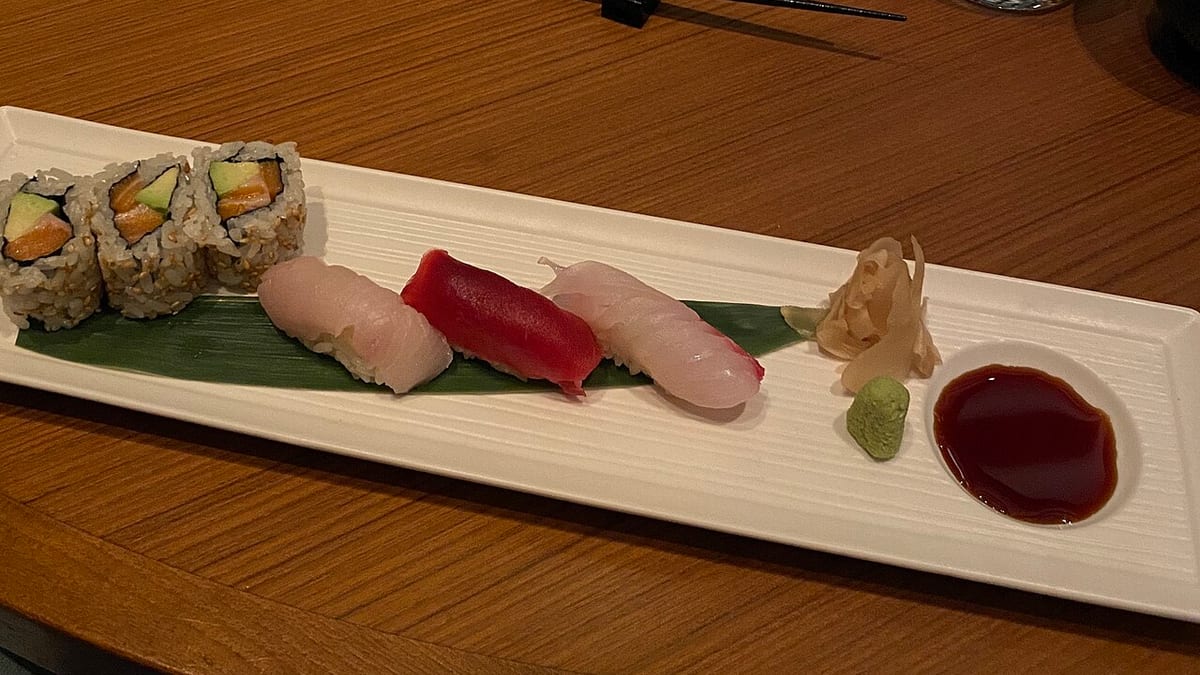
The à-la-carte menu lists a sushi assortment at €35 and chirashi sushi at €37, the latter marked as requiring reservation. Miso soup is €6. [2] An assortment plus that soup therefore totals €41 before drinks or additional dishes. This calculated example gives a more realistic dinner benchmark than comparing the assortment with the lunch headline.
Nonbe Daigaku: useful takeaway benchmarks, not dine-in promises
Nonbe Daigaku is at 31 Avenue Adolphe Buyl in Ixelles. [7] Its official takeaway menu provides unusually clear examples: eight sushi and a maki roll cut into six pieces at €27, a one-person sashimi assortment at €29, and chirashi at €28. [3]
Those are takeaway listings. Do not assume that the dining-room menu, service or prices are identical. Decide first whether you want a restaurant evening or food to collect, then use the appropriate menu and reservation process.
For two people, two €27 assortments total €54 before any extras. That comparison is straightforward because it uses the same listed product twice. It does not establish that the quantity will suit every appetite, or that a larger platter elsewhere offers the same composition.
The menu also marks some ingredients as dependent on arrivals or market conditions. [3] Treat the assortment as a way of ordering a style of meal rather than a guarantee that every photograph or past review represents the fish available on your visit.
Choose this option when the selection of sushi itself is central to the plan and you are willing to travel to the relevant neighbourhood. It is less useful as a spontaneous central-city stop when the rest of your day is elsewhere.
Kamo: the splurge depends on the day you book
Kamo's official announcement sets prices effective from 1 April 2026: €90 for either lunch menu, €130 for Menu Kamo at dinner, €135 for Menu Sushi and €150 for the Grand Menu. From 1 May, lunch is Friday only; Thursday and Friday dinner offer only the Grand Menu. [4]
This is a more important distinction than a generic label such as expensive sushi. A Thursday booking is not an opportunity to choose the €135 sushi menu under the published schedule. Two Grand Menus total €300 before drinks and any other charges, while two Friday lunch menus total €180.
Choose the dinner when the multi-course experience is the purpose of the evening. Choose Friday lunch when that service fits both your itinerary and budget. Neither should be compared directly with the price of one roll or a takeaway assortment.
The restaurant requires online reservations and asks diners to disclose dietary restrictions in advance; it warns that the menu contains meat and gluten and that changes requested on arrival incur a supplement. [4] A sushi-labelled menu should therefore not be assumed to be fish-only or automatically suitable for a particular diet.
Make the reservation fit the meal you actually want
For a relaxed, unplanned stop, Makisu's walk-in model is the simplest fit. For a possible lower-cost chirashi lunch, Yamayu's availability condition is crucial. For an explicitly priced collection order, Nonbe's takeaway menu gives a clear starting point. For a special occasion, Kamo's service calendar should determine which day you book.
Tell the restaurant about ingredients you cannot eat before committing, especially where a set menu limits substitutions. Ask for the current menu rather than assuming that an old photograph represents today's offer. These are practical ordering decisions, not reasons to make the entire meal anxious or complicated.
The best sushi choice in Brussels is not automatically the cheapest plate or the longest tasting menu. It is the place whose format, location and confirmed terms match the experience you want - and whose final bill you understand before the first dish arrives.