An accessible Brussels visit starts with a complete route, not a list of supposedly accessible attractions. Check the hotel entrance, transport stop in the correct direction, boarding arrangements and destination access together. STIB distinguishes independently accessible stops from those requiring a companion's help, while railway assistance deadlines depend on the particular journey. Those conditions should shape the itinerary. [1][2]
Build the trip around your own access requirements
Before choosing a neighborhood or sightseeing pass, write a short description of what you need. Include wheelchair dimensions, whether you can transfer, whether you travel independently, and any requirement for a roll-in shower or a particular toilet arrangement. A property's general accessibility label does not answer those questions.
Ask accommodation providers for measurements and photographs of the actual room offered, not an example room elsewhere in the building. Clarify the route from street to reception, reception to lift, and lift to bedroom. A step-free bedroom reached through an unsuitable entrance does not solve the problem; neither does an accessible bathroom that is available only in another room category.
Keep the first day geographically modest. One confirmed museum and a nearby meal create a better arrival plan than several unfamiliar transfers. Once you have tested the local journey and seen how much effort it takes, you can make a more realistic decision about a longer excursion.
Allow for different experiences within the same travel group. Someone who can walk a short distance but cannot stand in a queue may need seating and timed entry more urgently than a ramp. Describe that need explicitly instead of allowing staff to assume that all reduced-mobility requests are identical.
Read STIB's accessibility symbols correctly
STIB's blue wheelchair symbol identifies a stop intended for independent wheelchair access. The orange symbol, showing a wheelchair user with a companion, identifies a practicable stop where help is needed. A stop without either symbol is not classified as accessible or practicable. The operator's stop search lets you select the direction of travel, which matters because opposite platforms can differ. [1]
Use that distinction when planning both halves of a journey. It is not enough to confirm that the boarding stop near your hotel is accessible; you also need a suitable destination stop and a workable return. An alternative one stop farther away may be preferable to a shorter route whose final platform requires assistance you do not have.
For metro stations, a grey wheelchair symbol means lifts or ramps are provided. Their current operating status must still be checked in the STIB app or website. STIB also offers free metro assistance daily from 07:00 to 23:00. Assistance is a separate service from the ticket needed to travel. [1]
Before leaving, save the station exit and lift location as well as the line name. A journey planner may deliver you to the correct station without explaining which street entrance reaches the lift. When an outage removes the only suitable exit, reconsider the route before boarding rather than hoping the problem will be resolved by arrival.
Railway assistance: the three-hour rule is conditional
SNCB offers free assistance, but its shorter booking deadline is not universal. Requests up to three hours before departure apply to direct journeys between 06:30 and 21:00 between specified stations. Brussels-Midi, Brussels-Central, Brussels-North and Brussels Airport-Zaventem are included. Journeys involving a connection or other stations generally require at least 24 hours' notice. [2]
The operator asks passengers to reach the confirmed meeting point 20 minutes before departure with their travel ticket. Reserve assistance for the actual trains and stations you intend to use, and retain the confirmation. Buying an ordinary railway ticket alone does not communicate a ramp or boarding-assistance requirement. [2]
This changes how to plan a day trip. A spontaneous direct outing between eligible stations may be possible under the shorter arrangement; a journey with a regional connection can need earlier organization. Do not judge the assistance requirement from the length of the trip. The boarding and transfer conditions matter more than distance.
For international rail travel, use the booking and assistance instructions for your particular operator as well. A domestic SNCB arrangement should not be assumed to cover the international train automatically. A generous transfer gives staff room to coordinate assistance without forcing you to choose between a rushed connection and a missed service.
Arriving by air without losing the onward connection
Brussels Airport advises requesting assistance through the airline at least 48 hours in advance; the airport service itself is free. Describe the assistance needed through the terminal and disclose mobility equipment requirements to the airline. Airport assistance and the onward train arrangement are separate parts of the journey. [3]
Avoid reserving the tightest possible onward connection. Disembarkation, returning a mobility aid and reaching the railway meeting point all need usable time. A flexible onward plan is particularly valuable when you cannot independently switch to a different train after a delay.
Keep essential equipment information with you rather than only in checked baggage. Record the dimensions and handling instructions you supplied at booking. That is practical preparation for explaining the equipment consistently to different teams, not a substitute for the airline's own carriage requirements.
Choose attractions by the experience you can actually reach
The central Magritte Museum gives useful detail rather than a simple accessibility badge. Its guidance identifies Place Royale 2 as the reduced-mobility entrance, allows manual and electric wheelchairs, and provides accessible toilets. Mobility scooters are not allowed in the galleries; a wheelchair can be borrowed instead, so scooter users should discuss whether transferring is workable before booking. [4]
That central museum must not be confused with the René Magritte house museum in Jette. The latter's own visitor information says its listed building is not accessible to visitors with reduced mobility or pushchairs. A search result for "Magritte museum accessibility" can therefore answer the wrong question unless you confirm the address. [5]
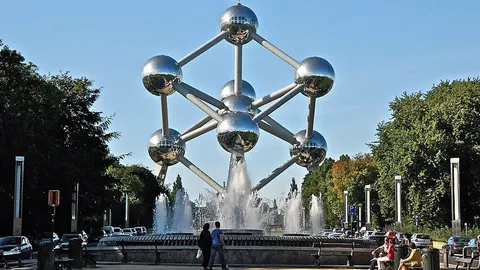
The Atomium illustrates another important limitation. Its usual wheelchair-accessible experience is restricted to the panorama rather than the entire exhibition route. At publication, the operator reports that the panorama is temporarily unavailable. A general statement that the attraction has a lift does not establish a worthwhile wheelchair visit under those conditions. [6][7]
Contact an attraction about the specific experience that interests you: the main collection, temporary exhibition, viewing platform or restaurant. Ask whether accessible toilets lie on that route and whether the exit remains step-free. This produces more useful information than asking only whether wheelchairs are admitted.
Make a workable plan, including a fallback
A good first-day plan has a confirmed arrival arrangement, an accessible hotel room, one suitable attraction and a meal location whose entrance has been checked. Keep a nearby alternative for the museum slot rather than a backup across the city that introduces unfamiliar transfers.
Save assistance confirmations, venue contacts and a screenshot of the chosen transport route together. On the day, check the operational information that can genuinely change the journey, especially lifts. The objective is not to investigate every possible obstacle in Brussels; it is to establish a small number of reliable routes that let you spend the visit on the things you came to enjoy.