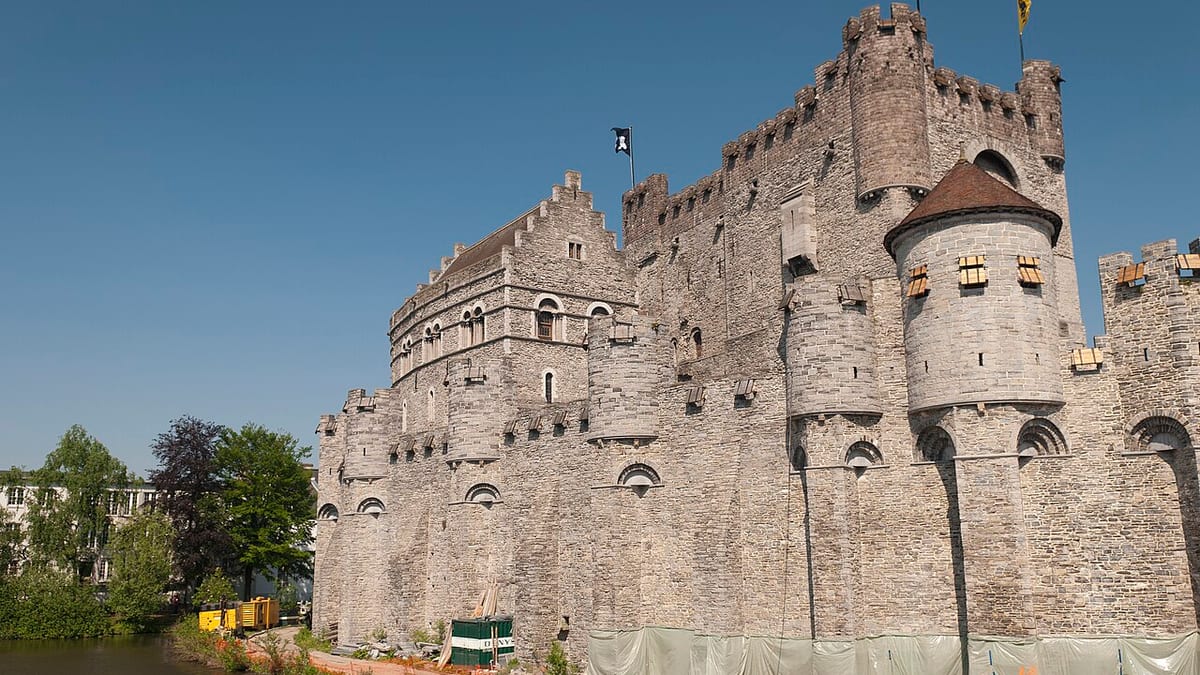
Gravensteen is worth visiting for its imposing fortress architecture, elevated city views and unusually entertaining interpretation, provided you can manage a stair-heavy route. It is not a furnished royal-palace experience or a wheelchair-accessible attraction. For a Brussels-based traveler, it works best as the main booked stop in a Ghent day trip rather than a rushed detour between cities. [1][2]
What makes the visit more than a photograph
The castle's exterior makes an immediate impression, but entering changes your relationship with the building. Instead of looking at a defensive silhouette from the street, you move through its gatehouse, keep, rooms and ramparts. The city's visitor guide identifies those elements as part of the public experience. [1]
Look at the building as an expression of power rather than simply a picturesque medieval backdrop. The inscription over the entrance associates Count Philip of Alsace with its construction in 1180. Its later life was very different: the complex became industrial premises, including a cotton mill, before restoration helped turn it into a major visitor attraction. What you see is therefore a monument with several lives, not an untouched scene preserved from one medieval afternoon. [1]
That history gives the visit a useful structure. First notice how the fortress controls space and views; then consider how the same rooms could have been repurposed. You do not need to memorize rulers or architectural terms to appreciate the contrast between a count's stronghold and a place of industrial work.
The experience is strongest when you enjoy buildings as much as collections. Visitors expecting many richly furnished domestic rooms may find the castle less satisfying than those interested in stonework, defensive design and the physical act of moving through a fortress.
The audio guide changes the tone
The included audio guide is an important part of the value. Ghent's tourism office describes Wouter Deprez's interpretation as a comedy tour, combining historical storytelling with humor. A shorter "Big Five" audio option covers key features in about half an hour. Neither description means that the entire visit, including walking and views, will take only thirty minutes. [1][3]
Choose the longer narrative when the castle is your main attraction. Choose the shorter format when attention spans or the rest of the day call for a more selective visit. There is no advantage in starting a long commentary and then becoming irritated because it conflicts with a lunch reservation you made too tightly.
For visitors who are deaf or hard of hearing, the operator provides a visio guide with Flemish or International Sign and written text. It is included in admission, and advance reservation is recommended. That is a meaningful access provision, but it does not remove the building's physical barriers. [2]
Some displays concern torture and judicial history. Parents should consider how their children respond to that material rather than assuming every castle attraction has the tone of a storybook adventure. It is reasonable to concentrate on the structure and views and give an uncomfortable display less attention. [1]
Tickets: book for certainty, not an online discount
The standard adult ticket is €15. Published age-based rates are €7.50 for visitors aged 19–25, €3 for ages 13–18 and free admission through age twelve. The audio guide is included. The operator states that online and on-site prices are the same, so booking ahead primarily secures availability rather than a lower rate. Online purchases are non-refundable. [3]
For two adults and two children aged ten and fourteen, those rates produce a €33 admission total. This is a worked example, not a dedicated family ticket. Bring any evidence required for a concession and include all visitors when making the reservation, including those with free entry.
CityCard Ghent has a different arrangement: holders do not need to reserve a time slot. Confirm that you possess the Ghent product, not a Brussels sightseeing card, before relying on that benefit. Buying a city pass solely to enter one €15 attraction is a separate value calculation; add the other visits you genuinely intend to make rather than the maximum number theoretically included. [3]
The stairs are the deciding factor for many visitors
Gravensteen's official access page states that the castle is not wheelchair accessible. It describes more than 480 steps across the building and four narrow spiral staircases linking levels. The figure describes the castle's stair provision, not a promise that every visitor must climb every step, but it makes the nature of the experience unmistakable. [2]
Anyone with balance difficulties, painful stairs or limited stamina should use that information before paying, not discover it at the first tower. Being able to reach the entrance does not mean being able to complete the visitor circuit. A companion's free admission does not make an inaccessible route accessible.
Wear shoes suited to steps and keep your hands as free as possible. With a small child, think about how you will negotiate the stairs without relying on a pushchair. A compact day bag is more practical than luggage carried between hotels.
There are no lockers or cloakroom. The operator says bags may sometimes be left in the stables at the owner's risk if space is available, which is not equivalent to a guaranteed secure storage service. Arrange storage elsewhere when visiting between train journeys. [3]
How to fit the castle into a Ghent day trip
Use the castle address, Sint-Veerleplein 11, as the destination for the final local journey. An intercity train arrival at Gent-Sint-Pieters is not arrival at the castle entrance. Plan that station-to-center leg separately and avoid tying a non-refundable entry to the earliest possible connection. [3]
I recommend reserving around ninety minutes to two hours for the castle, depending on your interest in the commentary and pace on stairs. This is an editorial planning allowance, not a measured average. Add separate time for reaching the entrance, collecting equipment and returning anything borrowed.
The published opening pattern is daily 10:00–18:00, with last admission at 16:40 and closures on 24, 25 and 31 December and 1 January. An earlier slot is easier to combine with a relaxed meal and time outdoors than an arrival at the cutoff. [3]
For a first visit from Brussels, make the castle the anchor and keep the surrounding Ghent walk flexible. Trying to add a second distant city on the same day reduces the time available for the very experience you bought. Conversely, travelers who mainly want the exterior and cannot comfortably manage stairs should feel no obligation to enter: spending that time elsewhere in Ghent can be the better decision.