WOLF Food Market is worth visiting when your group wants different cuisines in one central setting, or when a casual meal fits better than a formal restaurant. It is less compelling as your only opportunity to eat traditional Belgian food. The most important practical distinction is between the venue being open and its kitchens actually serving meals. [1]
A useful meal stop, not a compulsory attraction
Visit Brussels places WOLF at Rue du Fossé aux Loups 48C, also written Wolvengracht 48C. Its central location and collection of restaurant stalls make it a practical option to consider within a sightseeing day, rather than a destination that needs an entire itinerary built around it. [2]
The best reason to choose it is disagreement about dinner. One person can pursue pizza, another a bread-based Syrian meal and another Greek street food without the whole group committing to a single restaurant menu. Those are real offerings, not merely examples of what a generic food hall might contain. [3][4][5]
The trade-off is that a multi-kitchen meal needs some coordination. Do not expect it to unfold like a restaurant dinner in which one server brings everyone's courses together. For a celebratory meal where pacing, a guaranteed table or a quiet conversation matters most, a conventional reservation may be the better choice.
The old bank is part of the appeal
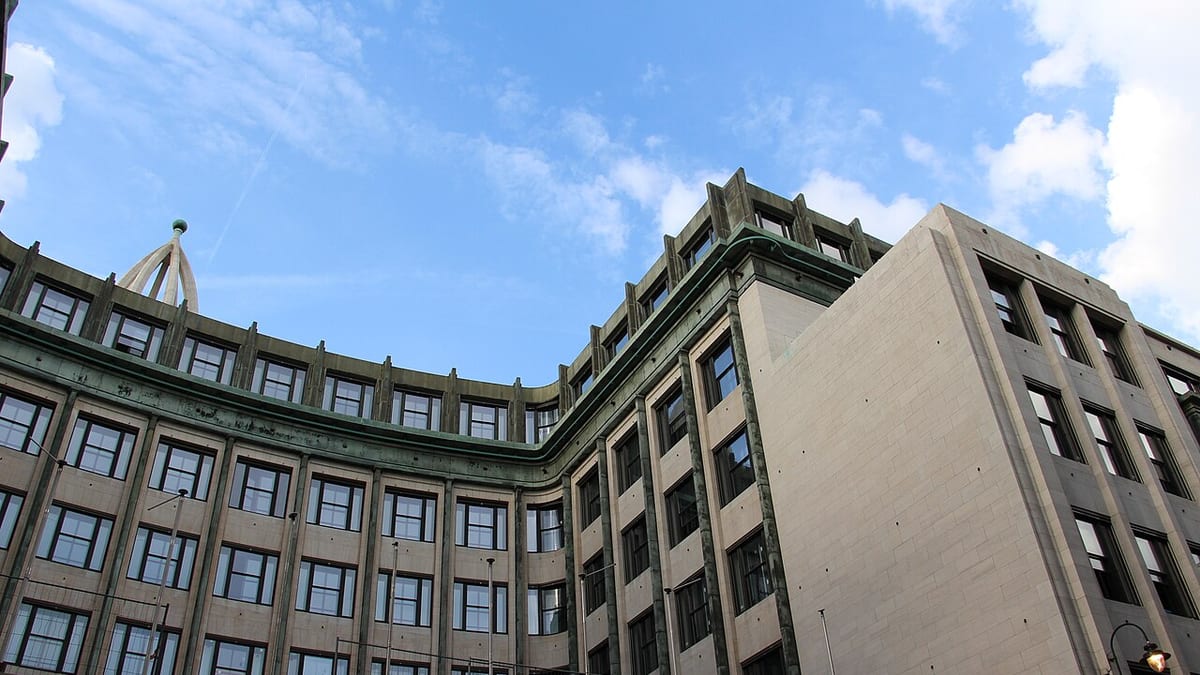
WOLF occupies a former banking space. Its own history identifies the ASLK headquarters and counter room associated with architect Alfred Chambon, and explains how interior designer Lionel Jadot reused elements of the old bank when creating the food market. This is more specific than the usual "industrial atmosphere" description. [6]
Former counter signs and desks were repurposed as lighting; marble counter panels were reused at the bar, and elements associated with the glass ceiling became decoration. Looking for these reused materials gives the interior a second layer of interest while you are deciding what to eat. [6]
Treat that architecture as an enjoyable addition to lunch, not a reason to order a meal you do not want. A venue can have an inventive interior without every kitchen being the best match for your taste, appetite or budget.
Choose a kitchen by the meal you actually want
My Tannour is the useful option to investigate for oven-baked bread and Syrian-influenced street food. The venue describes its tannour as a clay oven used to bake bread at high heat. Choose it because the bread-led meal appeals, rather than assuming every food-hall plate offers the same style of lunch. [4]
IDEA describes its WOLF operation as Greek street food built around pita bread. This is distinct from the brand's sit-down restaurant experience elsewhere. When checking a menu or making plans, make sure you are looking at the WOLF branch rather than a different IDEA venue. [5]
La Piola Pizza offers a Neapolitan approach. Its WOLF description emphasises the dough and short, hot bake, producing a softer result than a rigidly crisp pizza base. That makes it a sensible candidate for someone seeking that style; it is not a claim that it will suit every pizza preference. [3]
These choices are selected for their different formats and their documented presence at WOLF, not from a personal tasting exercise. Compare the current menus before deciding. A long vendor list matters less than whether two or three kitchens genuinely suit your group.
Ordering without making the meal unnecessarily complicated
WOLF allows both counter ordering and phone ordering through a QR code, with a notification when food is ready. The phone option can simplify the transaction, but it should not be understood as a guarantee that every dish will be ready at the same time. [7]
For a group, agree where you will meet and which items are intended to be shared before placing orders. Otherwise, it is easy to buy several similar sides or have one person waiting with food while another is still choosing a kitchen. A brief menu discussion is often more useful than trying to optimise every individual order.
Bring a payment card. WOLF's general FAQ says cash is possible, but My Tannour's own WOLF listing specifies cashless payment. That discrepancy is a reason not to assume a venue-wide payment statement applies identically at every stall. [7][8]
The weekday afternoon gap matters
The published food-service information separates lunch and dinner on weekdays: 12:00–14:30, then service restarting at 18:00. My Tannour's own branch schedule independently shows that same weekday break. A plan to arrive at 16:00 on a Tuesday for a full choice of hot meals is therefore not supported by the published kitchen hours. [1][8]
Weekend food service is listed as continuous from noon. However, WOLF's home page and FAQ do not give perfectly consistent final closing times, and individual kitchens can publish their own schedules. Aim well before the final half-hour and confirm a particular stall's last orders when arriving late. This is a kitchen-service issue, not simply a question of whether the building's doors are open. [1][7]
For a sightseeing day, that suggests two straightforward uses: a deliberate lunch stop before the weekday break, or an early dinner after service resumes. Do not leave lunch unresolved until mid-afternoon and assume a food hall automatically solves it.
Group bookings, dietary needs and what the bill means
WOLF's standard table reservations are for groups of at least 20, and its FAQ excludes bookings from Friday evening through Sunday lunchtime. A couple or small family should therefore not plan around obtaining a normal restaurant-style reservation through that policy. A large group needs an explicit confirmation, not just agreement among its members to arrive together. [7]
Vegetarian and some vegan choices are advertised, while halal options depend on the individual restaurant. Ask the kitchen about the particular dish and any important ingredient or preparation requirements; a food hall's broad category label is not a substitute for an answer about your meal. [7]
There is no single meaningful "WOLF meal price" across all those choices. Use the live menu to add up what you actually intend to order, including drinks and extras. For example, a hypothetical €18 main plus a €4 drink produces a €22 meal; adding a €6 dessert makes €28. Those figures illustrate budgeting, not verified menu prices. [9]
The on-site microbrewery is another reason some visitors choose WOLF, but a meal does not automatically include a brewery visit. The operator invites tour enquiries for groups of eight or more. Treat that as a separate arrangement rather than assuming an individual diner can join a scheduled tour on arrival. [10]
Choose WOLF for flexible eating and an interesting reused building. Choose another restaurant when your priority is one particular Belgian dish, a reserved small-group table or a carefully paced dinner. That distinction is more useful than declaring the food market either essential or a tourist trap.
Source & editor notes
This is a format-and-practicality assessment, not a firsthand restaurant review. WOLF's own pages differ on closing times and restaurant counts; the guide avoids a fixed count and highlights the weekday kitchen break. The live ordering menu did not expose readable prices during research. The cost example is explicitly hypothetical, and one tenant's cashless policy differs from the general FAQ.