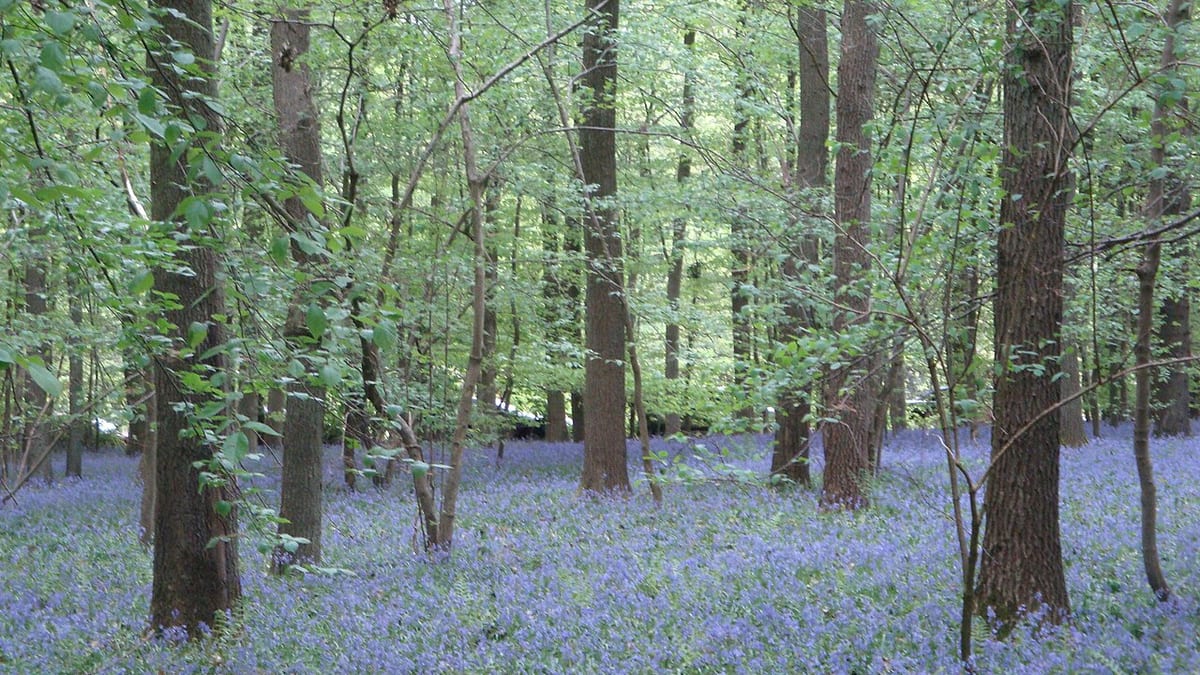
Visit Hallerbos for bluebells when the forest's own flowering reports show that the display is developing, not simply because a calendar says April. The flowers vary with the weather, and the best visual effect also depends on the beech leaves. Choose a marked route that suits your walking ability and stay on the official paths throughout. [1][2][3]
When is the bluebell season?
The Hallerbos website describes flowering around mid-April, but its detailed guidance stresses that the plants do not bloom at the same time every year. It recommends following the annual reports when you cannot visit regularly from late March. [1][4] A fixed peak weekend advertised months in advance is therefore a planning guess, not a botanical guarantee.
The forest also explains that the period just after the beech leaves open can produce the most attractive combination of purple flowers and fresh green foliage. As the canopy develops, less light reaches the forest floor. [1] The question is not only whether flowers remain present, but what stage the woodland has reached.
For a flexible Brussels itinerary, keep more than one possible day for the visit and choose nearer the time. For a trip organized entirely around the bluebells, accept that weather can change the display even when your accommodation and transport are fixed.
As of publication on 28 October 2026, the 2026 flowering season is over. The next spring's exact bloom and special transport arrangements are not confirmed by the 2026 pages. Do not interpret a still-visible spring notice as a current autumn event or a guaranteed 2027 schedule.
Choose the trail for the visit you want
The official walking page lists three established marked routes. The Plateau walk is four kilometres and designed for visitors with limited mobility, with white-and-black markers. The Sequoia walk is 5.3 kilometres with blue markers, while the seven-kilometre Roebuck walk uses yellow markers and follows a more adventurous route through valleys. [2]
Those are different experiences, not simply short, medium and long versions of the same flower walk. A visitor primarily interested in a manageable bluebell outing should not choose the longest route merely because it sounds more complete.
The spring page also describes two dedicated bluebell walks of 4.8 and 5.1 kilometres and a separate access walk from another parking area. [2] Access distance matters: the length of the loop is not always the distance you will walk from the place where you arrive.
For a first visit, choose one route and allow room for pauses. Trying to combine several loops can make it harder to return to the correct transport stop and may add more repetitive walking than new scenery.
The accessible option is more than a shorter path
The Plateau walk begins at Parking 4, Dries 3, and is identified as suitable for wheelchairs. [2] The regional tourism authority also describes adapted benches, picnic tables and tactile information panels along this route. [5] This is more useful information than a vague statement that the whole forest is accessible.
Match the arrival arrangements to that route. A distant bus stop or car park can add a section that is not equivalent to the adapted loop. Someone who can comfortably manage the Plateau walk may still need a carefully planned transfer to its start.
During the 2026 festival, Parking 4 was reserved for holders of the relevant disability parking card. The published accessible shuttle arrangements also had limitations, including an exclusion for electric wheelchairs on the small internal shuttle. [3][5] These are past-season operational details that demonstrate why the next edition must be checked separately.
Explain the actual mobility requirement when seeking advice. Wheelchair access, limited walking endurance and difficulty with uneven ground are not interchangeable needs, and a single accessibility label cannot resolve every part of the journey.
Protecting the flowers is part of the visit
The forest's visitor rules require people to remain on official paths, including when taking photographs. A gap in a rope does not create permission to enter the flowers, and an apparent track that is absent from the official map is not necessarily an authorized path. [3]
Choose your photograph from the path rather than moving the subject into the bluebells. Wait for a clear view, use the available angle or accept that the composition you imagined is not possible without damage. The quality of the visit does not depend on standing inside the display.
The guidance also requires dogs to be on a lead and prohibits picking flowers and flying drones in the forest. [3] A quiet visit is not an exception to those conditions. The same limits apply when no other visitors or staff are immediately visible.
For children, explain the path rule before entering the flowering area. Make looking for differences in leaves, light and colour part of the activity, rather than treating the flowers as a surface to run through. That preserves the outing without turning every few steps into a correction.
Plan the journey as well as the walk
Halle station is not the forest entrance. The 2026 visitor information gives a distance of 4.9 kilometres between the station and Hallerbos and describes bus and seasonal shuttle arrangements. [3] Walking that connection in both directions adds almost ten kilometres before counting the woodland route.
For example, combining those two station walks with the four-kilometre Plateau route would produce roughly fourteen kilometres in total, before small deviations. That is an approximate calculation from the published distances, not a recommended accessible itinerary.
The practical lesson is to decide how you will cover the final connection. A train journey to Halle followed by an appropriate bus, booked transfer or confirmed seasonal shuttle can be very different from treating the station as the start of a short forest stroll.
The Dutch festival information states that forest admission is free and advises bringing water because there is no catering within the woodland. [6] Pack what you need for the chosen walk rather than assuming a café will appear halfway around the route.
Is Hallerbos worthwhile outside the flowering peak?
The forest's own description highlights its giant sequoias as another reason to visit, and the marked walking routes are not all designed solely around bluebells. [2][4] Choose an off-season outing for a woodland walk, not for a purple display that is no longer present.
This distinction helps avoid disappointment. Someone who enjoys trees, walking and a quieter change from city streets may value the trip outside spring. Someone whose only goal is photographing the bluebell carpet should wait for the appropriate season and current reports.
For a successful bluebell visit, three decisions matter most: travel when the actual flowering supports it, choose a route and arrival point that fit your group, and remain on the paths. Those choices do more for the experience than chasing an exact date or trying to see every corner of the forest.