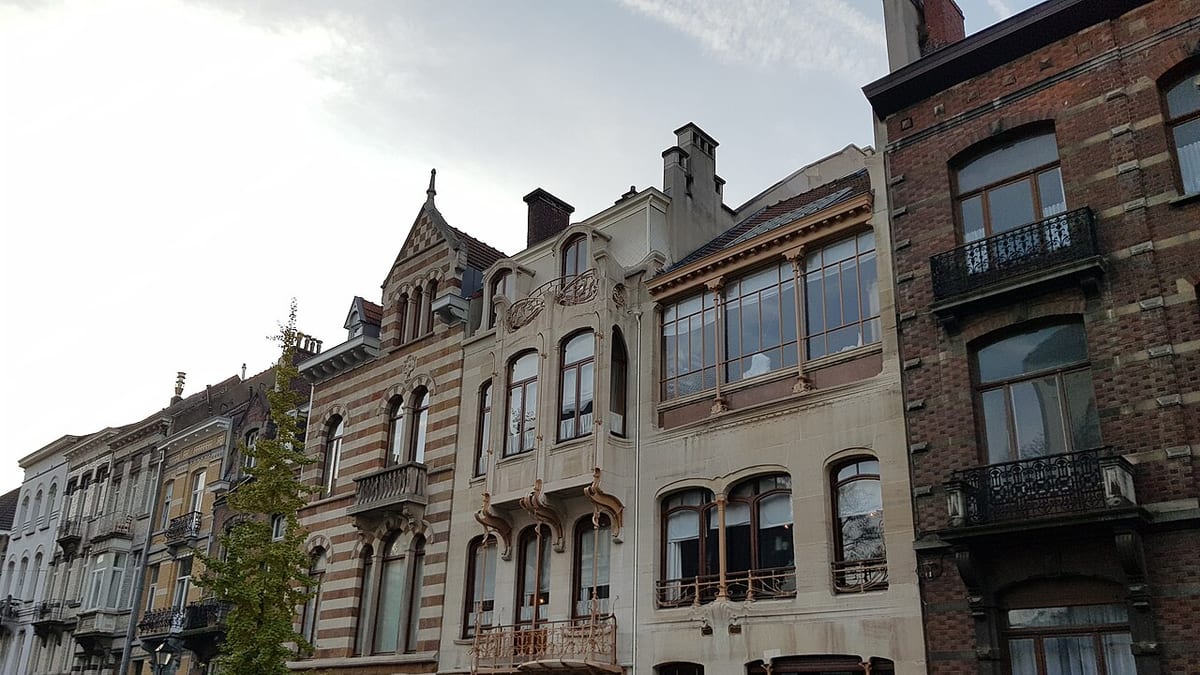
The Horta Museum is worth visiting to understand Brussels's Art Nouveau through an actual home rather than a collection of objects. Its appeal is the relationship between light, rooms and decoration. Make an advance reservation, give the visit an unhurried place in your day, and do not assume a historic house offers the same access as a modern gallery. [1]
What makes the house different from another museum
Victor Horta designed these adjoining buildings as his home and workplace between 1898 and 1901. They are among the four Horta town houses included in the UNESCO World Heritage inscription. UNESCO identifies the combination of open planning, light, structural materials and decoration as central to their architectural importance. The point is not simply that the rooms contain attractive furniture: the spaces themselves are the principal exhibit. [2]
That makes the museum a particularly good choice for visitors who enjoy noticing how a building works. Instead of searching for a single famous object, follow how one level relates to another and how the staircase draws attention upward. Ask yourself where the light comes from, which elements carry weight, and which details make an ordinary domestic action feel deliberately designed.
You do not need specialist knowledge to enjoy that exercise. Someone who has only seen Art Nouveau façades can use the house to connect an exterior style with an interior arrangement. Conversely, a visitor who prefers large narrative displays, interactive activities or an extensive painting collection may find this a less natural fit.
A home, a studio and an entrance at a different number
The historic house is at number 25 Rue Américaine and the studio at number 23. The museum's visitor entrance is at number 27, in the neighbouring annex. Use that entrance address when planning your arrival rather than treating the two historic doorways as separate ticket offices. [3]
The museum explains that the annex took over functions such as reception and visitor services, allowing the historic spaces to be presented more clearly. It also distinguishes the domestic rooms from the former professional spaces. Looking at both sides helps explain how Horta organised private life and architectural work on adjoining plots. [4]
There is an important qualification to the idea of a preserved home. The museum describes a long process of restoration and reconstruction, while some furniture and objects were brought in to evoke the period. Do not assume every item has stood in precisely the same place since Horta lived here. The architectural ensemble remains the reason to come; the presentation is also the result of conservation decisions. [4]
For a focused visit, concentrate first on the relationships between spaces, then on materials and smaller details. Trying to photograph or mentally catalogue every decorative element can distract from the main lesson: how the whole interior holds together.
Booking, admission and the best place in your day
Use the museum's official hortamuseum.be booking route. The museum says advance booking is the way to secure entry, and the museum-pass listing also requires an online reservation. A pass that covers admission does not remove the need to obtain a place. [1][5][6]
The published standard admission is €14. Two adults paying that rate would spend €28, before transport or anything else they choose to buy. Reduced categories and pass eligibility should be selected in the official booking system rather than inferred from an older guide or a reseller's package price. [7]
Brussels Museums lists opening from 14:00 to 17:30 Tuesday–Friday, and 11:00 to 17:30 on Saturday and Sunday, with Monday closure. The practical difference is useful: on a weekday, use the morning elsewhere and make Horta your afternoon appointment; at the weekend, a late-morning booking can leave the afternoon free. [3]
Allow roughly 75–90 minutes as a planning allowance, not a promised tour duration. Choose a slot comfortably before closing rather than trying to fit the entire experience into the final admission period. Published listings do not agree perfectly on last-entry and weekend closing details, so the time offered on your actual reservation should govern your arrival.
The pass operator lists 11 November among the museum's closure dates. That matters for a November 2026 visit: a weekday opening pattern is not proof that the museum opens on a public holiday. [8]
Free entry and temporary exhibitions
Brussels Museums lists free admission on the first Sunday of the month, and both the Art Nouveau Pass and museumPASSmusées among accepted passes. These are useful savings only when they match your travel dates and the museum's reservation arrangements. Do not move an entire short break to a supposedly free day without first securing the relevant admission. [3]
A temporary exhibition can add a second reason to visit. The museum-pass programme lists "Art nouveau versus Art Déco? 1850–1950: un siècle en 31 sièges" from 25 June 2026 to 10 January 2027. It offers a furniture-focused complement to the house, but those dates should not be carried forward into advice for a later trip. [8]
For someone choosing between an architectural visit and a decorative-arts exhibition, seeing both on the same outing may improve the value. For someone interested only in the building, the exhibition is an addition rather than the justification for buying a ticket.
Mobility needs and a sensible neighbourhood plan
Do not read a general accessibility icon as a promise of a fully step-free historic-house route. The Brussels Museums listing specifically refers to assisted access for mobility-impaired pedestrians. Contact the museum with your actual requirement: whether you use a wheelchair, can manage some stairs, need regular seating or must avoid particular parts of the route. Ask which rooms are reachable, not merely whether the reception area is accessible. [3]
That distinction also helps families or mixed-mobility groups decide whether everyone will enjoy the same visit. An attractive building is not automatically the right shared activity if a central part of it would be unavailable to one person.
Keep the rest of the outing geographically restrained. Saint-Gilles is the museum's setting, and Brussels's architecture programme offers further Art Nouveau visits beyond this one house. Choose an additional interior because you want a comparison, not because collecting several entry tickets seems more efficient. [9]
For one available architecture session, Horta is the stronger choice when your question is how Art Nouveau shaped domestic space. Villa Empain offers a different combination of Art Deco architecture and changing exhibitions. Visiting both can be rewarding, but they answer different questions and should not be treated as interchangeable versions of the same museum. [10]
The best reason to reserve Horta is therefore specific: you want to spend time inside a building whose layout matters as much as its decoration. With that expectation, a carefully timed visit can be more revealing than a much longer circuit of façades.
Source & editor notes
The useful distinction is between Horta's historic house and studio and the visitor entrance at number 27. Opening listings differ at the end of the day; the booked slot governs arrival. Full room-by-room accessibility was not verified. This assessment is based on the museum, its museum-network partners and UNESCO, not a firsthand visit.