The central Magritte Museum is worth visiting when you want to explore one artist's ideas beyond his best-known images. Its paintings, advertising work, photographs and archives make it more than a gallery of familiar surrealist icons. Choose it for a focused art visit, but do not confuse it with Magritte's former home in Jette or expect every famous painting to be on display. [1][2]
First, make sure you are booking the right museum
The Musée Magritte Museum at Place Royale is part of the Royal Museums of Fine Arts of Belgium. The René Magritte Museum at 137 Rue Esseghem in Jette is a different institution, with its own opening schedule and visitor conditions. They are not two entrances to the same collection. [2][3]
For a first visit centered on the artist's work, the Place Royale museum is the more straightforward choice. Consider the Jette museum separately when the domestic setting and biographical context are what interest you. Searching only for "Magritte tickets" can conceal that distinction, so confirm the address before paying or entering a transport destination.
At the central museum, entrance arrangements also depend on whether you already have a ticket. Place Royale 2 is the entrance identified for online ticket holders; visitors without a ticket are directed to the main ticket desk at Rue de la Régence 3. Save the appropriate entrance, not merely the institution's name. [3]
That small preparation is especially useful when meeting someone or arriving in rain. Agree on the actual doorway and whether the group is buying tickets together, rather than assuming everyone will emerge at the same reception point.
What makes the collection rewarding
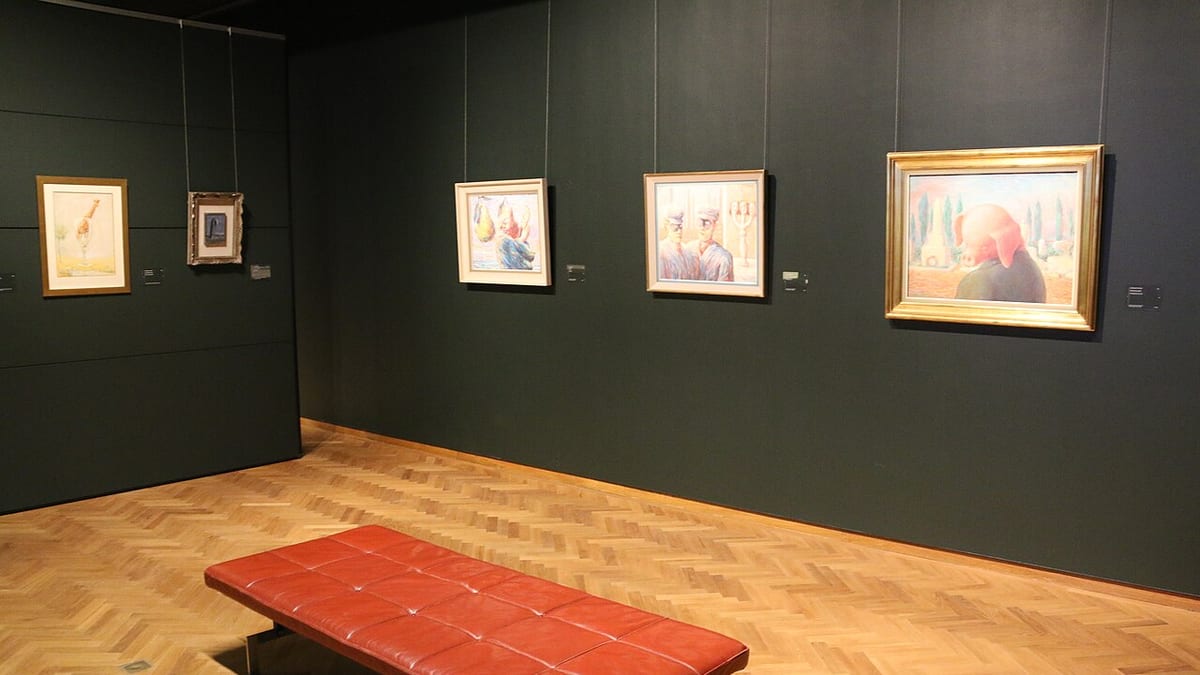
The museum holds more than paintings. Its description includes gouaches, drawings, sculpture, painted objects, advertising posters, photographs and film. That variety helps explain how Magritte worked with images across different settings rather than presenting him only as the maker of a few instantly recognizable motifs. [1]
The official circuit begins upstairs and moves downward through a chronological and thematic account of his life and work. The early section introduces artistic influences and the emergence of his surrealist work; later sections place his return to Brussels and advertising activity in context. Following that sequence makes more sense than rushing through rooms looking only for a painting seen on a poster. [4]
Give yourself permission to look before reading. Choose an image, describe what appears ordinary in it, then notice what disrupts that ordinary reading. Afterward, use the label or guide to test your interpretation. This is a useful way into surrealism even when art-history terminology feels remote.
The same approach works with children. Asking "What seems impossible here?" invites observation without demanding a correct answer. Keep the visit selective, particularly with younger visitors, rather than treating the full route as a test of endurance.
The collection changes through loans and display choices. A work appearing in a book, an old review or even a museum collection database is not a guarantee of its presence in the galleries on your date. Anyone traveling specifically for one painting should obtain current display confirmation before building the trip around it. [1]
Tickets: the useful comparisons
The published standard adult ticket is €13. Visitors aged 18–25 pay €5, and individual visitors under eighteen enter free. A combined adult ticket for Magritte and Old Masters is €20, compared with €26 for the two standard tickets bought separately. The €6 difference is a calculation from the current tariff, not an additional promotional discount. [5]
Choose the combination when you genuinely want both collections and can give them sufficient attention. The cheaper marginal cost of the second museum can be tempting, but two hurried visits are not automatically better value than one satisfying visit and time outdoors.
Audio and visio guides are listed at €5. The museum provides formats for adults, children and teenagers, as well as specific access needs. A guide can add useful context for a first visit; travelers who prefer to linger independently may be happier reading labels and choosing a smaller number of works. [5]
Permanent-collection admission is free on the first Wednesday of the month from 13:00, but that concession does not apply automatically to temporary exhibitions. Brussels Card also has permanent-collection rather than universal exhibition coverage. Free admission changes the price, not the need to understand the particular ticket or entry arrangement. [5]
For a couple comparing options, the practical choice is €26 for two standard Magritte entries or €40 for two combined adult entries. Add guides only for those who will actually use them. This makes the decision about interests and attention, not simply which product contains the largest number of rooms.
Timing the visit without a holiday mistake
Normal opening is Tuesday to Friday, 10:00–17:00, and weekends, 11:00–18:00; Monday is closed. The published closure calendar also includes 1 and 11 November, which matters immediately for an autumn visit. A Sunday opening pattern does not override the 1 November public-holiday closure. [6]
Plan around ninety minutes to two hours for a focused first visit. That is an editorial allowance, not a measured visitor average. Add more time for detailed reading, a guide or a second collection, and leave the final part of the visit free of a pressing restaurant or train deadline.
Do not use the closing time as the target arrival time. Ticket desks close earlier than the galleries, and entry checks can take time. An earlier arrival lets you slow down when a work interests you instead of calculating how many rooms remain. [6]
A useful sequence is museum first, then a flexible meal or walk. Reversing that order can work too, but a long lunch should not consume the time you intended for the collection. Keep the paid visit as a deliberate part of the day rather than an afterthought squeezed between other reservations.
Accessibility and whether it suits your group
The central museum permits manual and electric wheelchairs, provides an accessible entrance at Place Royale 2 and has adapted toilets. Its guidance does not permit mobility scooters in the galleries; a loan wheelchair is an alternative only when transferring is suitable for the visitor. Discuss that before purchasing, rather than assuming all mobility devices are treated identically. [7]
The Jette house museum has different physical limitations and states that it is not accessible for visitors with reduced mobility or pushchairs. That reinforces why the two institutions should not be merged into a single recommendation. [2]
Choose the central Magritte Museum when you are curious enough to spend time with a concentrated body of work. Skip the combination ticket when one collection is already enough, and do not judge the visit by whether it delivers every image you recognize. Its strongest value lies in seeing relationships between works and leaving with a better understanding of how Magritte made ordinary things feel unexpectedly strange.